|
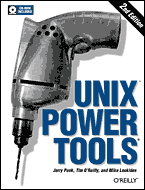
UNIX Power Tools, 2nd Edition is the perfect bathroom book for any UNIX afficionado. It's likely you could find something new, interesting, and useful every time you were to open the book. As the introduction says, UNIX Power Tools is "like an almanac, a news magazine, and a hypertext database rolled into one." The book is a massive collection of short, interlinked articles covering a large spectrum of what UNIX is all about. If you're looking to put that extra edge on what you can do with this venerable and powerful operating system, then get your hands around a copy and dive in. This is one thousand-page technical book that most likely wont end up as a doorstop or paperweight in your office.
Although the 2nd edition under review here is a bit dated (published in 1997), with UNIX being 30 years old, a great deal of the information covered is still very timely, and useful, especially to anyone new to UNIX who is dazzled by its sheer flexibility and steep learning curve. And, better yet, O'Reilly has just released a 3rd Edition offering updated coverage including MacOS X and Linux, as well as new coverage of several other areas.
So what is actually in the book? Well, just about everything you'd want to know about UNIX if you were just starting out (and plenty for the seasoned veteran as well). Heaps of information about working with shells, scripting, files, directories, processes, job control, finding your way around the filesystem (and lots of info about the filesystem itself), editing (via ed, ex, vi, emacs, sed, awk, and more), terminal settings and printing. When I was new to UNIX, this book was like a spell book to me, full of interesting and arcane incantations that I was itching to try out. Literally thousands of helpful tips and recipes fill the pages of this monster. And the lovely part about it all is that most of what is covered can be done right from a command-line. No GUI needed. CLI junkies will be in heaven as they browse the book's articles.
Networking and the X Windows system are not covered in this edition. As the authors point out, had they included in-depth coverage on those topics, the book could have easily weighed in at 2000 pages instead of the 1000 it already is. But as it stands, there is plenty there to keep you busy for a long while. The third edition addresses these gaps though, by providing chapters on network connectivity and basic X Windows usage.
The book uses a unique 'hyperlinking' system, in which any given article may point you midway to some other article. As such, reading this tome is akin to browsing the web, or at least like reading one of those old 'Choose Your Own Adventure' style books, where you kept your finger back at page 22, while you checked each possible option to make sure your protagonist didn't get squashed by a big elephant or something. If you're like me, you'll find yourself getting sidetracked often, and find yourself on a completely different topic than what you started with, but that's half the fun of this book. Follow the advice given by the authors—don't read it from cover to cover. Flip through it and find something interesting, and see where that takes you. And if you're like me, you'll find reading the book without a shell nearby somewhat frustrating. I find myself often itching to try out some cool trick while 'surfing' its contents.
True to its title, UNIX Power Tools empowers you by showing you numerous ways of how all the standard utilities and features of UNIX can be used together to accomplish whatever it is you need to do, as well as providing a collection of scripts and tools (available on an accompanying CD-ROM in the second edition, and available on the web for the third) that could prove very useful in many situations.
About the only downside to this edition would be its heavy slant towards the older Bourne and C shells. Mention is made occasionally of the newer bash and tcsh, but I imagine the third edition makes some good strides into better coverage for more modern shells. In one sense, though, by using straight Bourne and C shell examples, the applicability of the examples in the book is widened to more UNIX variants.
In summary, if you're new to UNIX, this book will be a constant companion as you climb the difficult learning curve, and develop mastery of the multitude of commands, shell features, and quirks that make up a modern UNIX system. Unix Power Tools will be the powerful spell book in your hands to help you develop your wizardry, and impress your friends at the local LUG meeting with apt one-liners which move mountains with keystrokes. And if you're not so new to UNIX, it will still be a helpful, and often entertaining almanac, with plenty of tips to offer. Finally, if you're a true wizard already, at least the article on cleaning out a full bit bucket will provide a smile to brighten up a cloudy day.
Overall Rating: 9/10
|